

Sourcing Level 2 Granite Countertops: The Santa Cecilia Light Advantage
May 09, 2026
Leave a message
In commercial construction, particularly within the hospitality and multi-family housing sectors, selecting the right hard surface is a strict mathematical balance between aesthetic upgrade and budget compliance. While Level 1 granites offer baseline functionality, developers increasingly specify Level 2 stones to increase property valuation and rental yields.
Among the vast geological catalog, Level 2 granite countertops are defined by more dynamic movement and richer color profiles than standard entry-level stones. Today, Stone Epic breaks down why Santa Cecilia Light dominates this category, and how our B2B manufacturing protocols solve the most common procurement failures for commercial developers.
The Santa Cecilia Light Advantage: The Ultimate Choice for Level 2 Projects
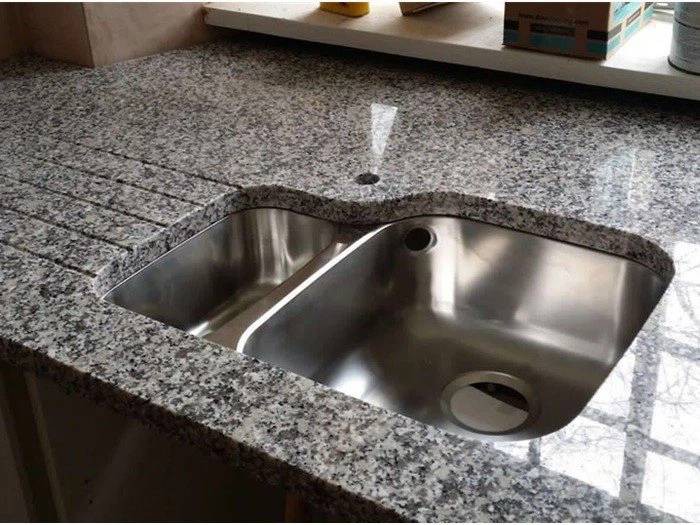
Sourced from Brazil, Santa Cecilia Light is a highly resilient igneous rock characterized by a consistent creamy-beige background, tightly packed with burgundy garnets and dark biotite clusters.
For commercial applications, this specific lithotype provides two massive advantages. First, its dense, complex particulate pattern acts as a natural camouflage against daily dust, water spots, and minor smudges, significantly reducing maintenance overhead for property managers. Second, its warm, neutral palette integrates perfectly with both dark wood cabinetry and modern white finishes, offering architectural versatility across hundreds of apartment units without feeling visually repetitive.
Our product

Solving Batch Color Shading Through Factory-Direct Procurement
The fundamental risk of sourcing natural stone in massive volumes is "color shading." Unlike engineered quartz, granite varies organically. If a trading company sources inventory from multiple small workshops, a single container might contain slabs with conflicting background tones-some yellow, some grey. Installing mismatched countertops within the same apartment complex is a catastrophic quality control failure.
Partnering directly with a dedicated Santa Cecilia Light granite factory eliminates this variable. At Stone Epic, we execute strict "block control" for commercial orders. We procure raw blocks extracted from the exact same quarry strata and process them sequentially. Our QC engineers grade and batch the polished slabs using photoelectric scanning before fabrication begins. This guarantees that all countertops delivered to a specific project phase maintain absolute chromatic uniformity, preventing costly on-site sorting and contractor disputes.
CNC Machining: Precision Undermount Sink Cutouts for OEM Orders
Procuring raw slabs is only half the equation; the true value for overseas developers lies in turnkey prefabrication. For prefab multi-family countertops, manual fabrication is completely obsolete. Hand-cut sink holes invariably result in uneven reveals, asymmetrical radiuses, and inconsistent edge polishing, which severely slows down plumbing installation at the job site.
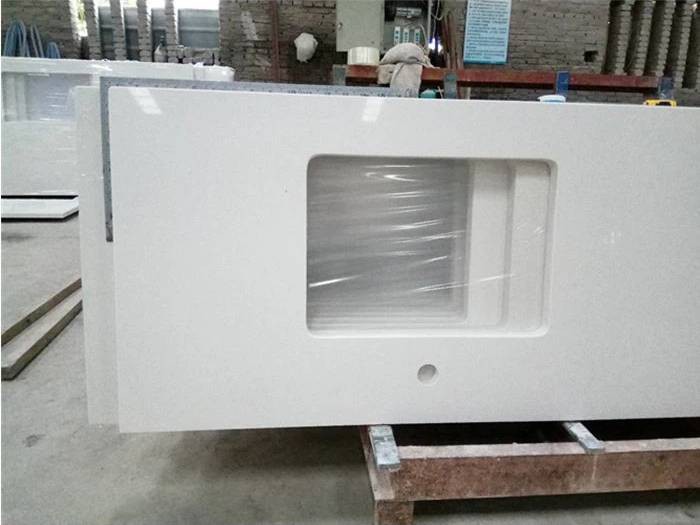
Stone Epic operates as an integrated OEM fabrication hub. We utilize heavy-duty 5-axis CNC routing centers to execute all undermount sink cutouts and faucet drilling. By inputting exact digital CAD templates provided by your architectural team, our spindles mill the interior sink edges with mathematical perfection. The internal profiles are then mechanically polished to a smooth, factory-grade finish, ensuring a flawless fit for standard stainless steel or ceramic sinks across thousands of units.
Steel Rodding: Preventing Transit Fractures in Prefab Deliveries
The primary logistical hazard of importing prefabricated countertops is structural failure during ocean transit. The moment a sink or cooktop cutout is milled into a slab, the structural integrity of the stone is compromised. The narrow strips of granite remaining at the front and back of the sink are highly susceptible to snapping under the continuous pitch and roll of a container vessel.
To guarantee safe delivery, our fabrication protocol mandates structural reinforcement. We utilize a specialized grooving machine to cut a channel into the underside of the granite, running parallel to the sink cutout. We then embed a high-tensile steel or fiberglass rod into this channel, permanently locking it in place with industrial-grade epoxy resin. This "rodding" technique drastically increases the flexural strength of the fragile bridge area. Combined with our face-to-face PE foam packaging and heavy-timber ISPM-15 crates, this engineering standard ensures your commercial inventory arrives intact, protecting your project timelines and your bottom line.