

Natural Stone Tolerances: What Global Stone Importers Need to Know
Jun 04, 2026
Leave a message
Natural Stones are Not 100% Identical: Defining "Natural Characteristics" vs. "Defects"
The foundation of effective wholesale stone quality control begins with a fundamental understanding of petrology and mineralogy. Unlike the highly controlled, mathematically formulated engineered quartz slabs produced at our affiliated Malaysia factory, In Quartz Stone SDN.BHD, natural granite is an igneous rock subject to millions of years of chaotic geological variation. For large-scale commercial and hospitality projects managed by Xiamen Stone Epic Co., Ltd., it is absolutely critical for procurement teams to technically separate a "natural characteristic" from a "processing defect."
A true manufacturing defect is a mechanical failure introduced during factory fabrication. This includes chipped edges caused by running dull CNC tooling at excessive feed rates, uneven thickness calibration that ruins installation leveling, or the deceptive application of chemical waxes to fake a high-gloss finish on a poorly polished slab. In stark contrast, variations in mineral grain flow, quartz concentration, and inherent background color shifts are natural geological signatures. They do not compromise the physical performance, compressive strength, or lifespan of the material; they are the defining, authentic traits of natural stone.
Objectively Evaluating Granite Color Shading and the Role of Sequential Batching
Because granite is formed through the slow, uneven cooling and crystallization of subterranean magma chambers, granite color shading is a physical inevitability when sourcing material across different strata of a quarry. The mineral mix of feldspar, quartz, and mica shifts dynamically inch by inch. However, "unavoidable" does not mean unmanageable. To mitigate extreme aesthetic shifts in commercial multi-family or sprawling hotel installations, strict factory-level sequential batching is mandatory.
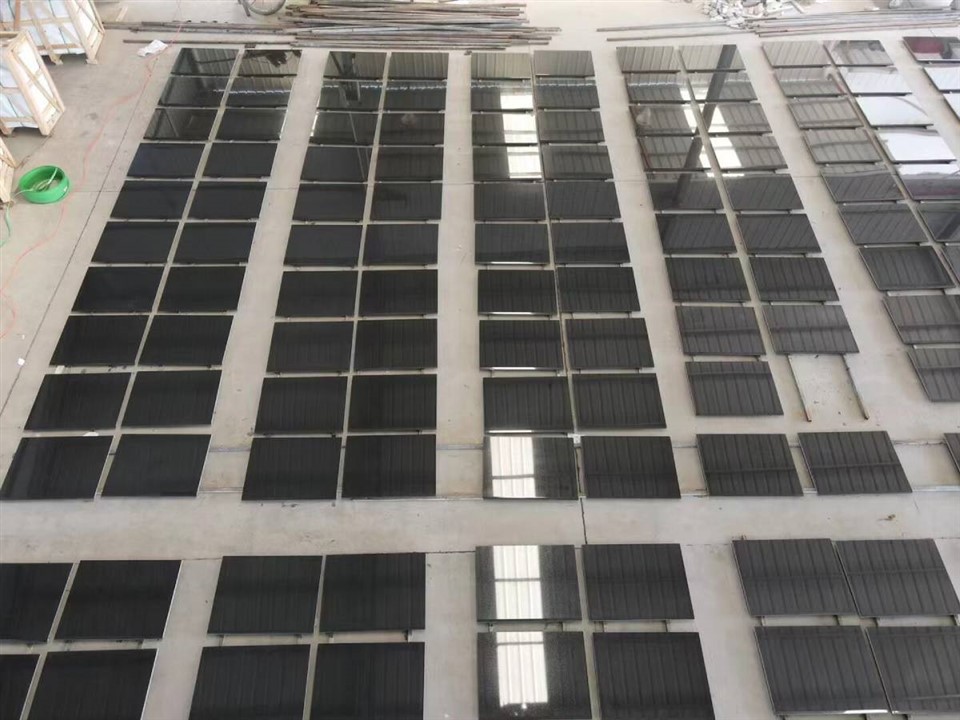
Sequential batching is a rigorous tracking protocol. When a raw block is sliced by a multi-wire or gang saw, every single slab is immediately numbered in the exact order it was cut (e.g., Block A, Slabs 1 through 50). By maintaining this strict sequence through the resin-treating, polishing, and container-loading phases, we ensure that any granite color shading transitions smoothly and organically across a large lobby floor or continuous kitchen countertops. Without sequential tracking, mixing random slabs from different blocks will create abrupt, high-contrast visual clashes that inevitably lead to job site rejections.
Our products


Industry Tolerance Standards for Biotite Clusters and Healed Quartz Veins
When drafting technical product specifications for an overseas factory, project managers must distinguish between structural liabilities and visual anomalies. For example, biotite clusters-concentrated spots of black mica-are prevalent in many popular commercial-grade granites. These clusters are entirely structurally sound. Within professional wholesale stone quality control frameworks, these are widely accepted, provided they do not exceed specific dimensional limits (e.g., clusters under 15mm in diameter are standard in Level 1 granites).
Similarly, healed quartz veins are frequently misidentified as physical "cracks" or fractures by inexperienced site inspectors. In reality, these are ancient geological fissures that were naturally filled and fused with molten crystalline quartz under immense tectonic pressure millions of years ago. These healed veins are actually stronger than the surrounding stone and do not compromise the material's load-bearing capacity. Recognizing these standard geological features prevents unnecessary project delays and costly cross-border disputes.
Establishing Clear Acceptance Criteria in Contracts
Vague contractual language regarding aesthetics-such as demanding stone that looks "perfect" or "beautiful"-almost guarantees a dispute upon arrival. Global stone importers must define exact physical tolerance ranges on paper before a single block is processed. This involves moving beyond signing off on a single, perfectly uniform 6x6 inch sample. Instead, professional buyers require "range samples" that display the absolute lightest, the median, and the darkest acceptable variations of the specified material.
Furthermore, commercial purchase orders should explicitly define the maximum allowable dimensions for natural mineral clusters and the acceptable frequency of healed veins per square meter. By replacing subjective aesthetic expectations with quantified, technical parameters, global stone importers partnering with Xiamen Stone Epic Co., Ltd. can lock in highly predictable project deliveries, eliminate destination port surprises, and build resilient supply chains.