

Engineering A Complete Ecosystem For Slovakian Two-Tone Memorial Bases
Jun 08, 2026
Leave a message
Why the Stela and Kerb Sets Cannot Be Sourced from Two Different Factories
In Slovakian and broader Central/Eastern European traditional cemetery culture, family memorial designs demand high structural integrity and solemnity. However, many overseas building material distributors, in pursuit of extreme low prices on single components, attempt to split their orders, sourcing the main stela and the underlying kerb sets from different OEM factories. This non-integrated procurement model is a major hidden risk in cross-border supply chains.
Natural stone extraction is batch-dependent. Even within the same variety, rough blocks from different quarry strata will exhibit macroscopically visible differences in grain density and background shade. More importantly, the precision of gang saws and the calibration standards of grinding heads vary across different factories. If sourced separately, when the goods arrive at the European installation site, color discrepancies or physical misalignment are almost inevitable. Therefore, treating the entire cemetery system as a complete engineering closed-loop and manufacturing the Slovakian two-tone memorial bases through an integrated, customized production line in a single professional factory is the fundamental logic to ensure the delivery quality of bulk B2B orders.
Chamfer Interlocking Technology Under a Unified CAD Coordinate System
Traditional Slovakian two-tone monuments heavily utilize high-contrast designs (e.g., splicing dark Cambodia G654 with light Cambodia Grey). This high-contrast visual effect places extremely stringent demands on the joint gap tolerances-any gap exceeding 1mm against a light background will form a highly visible dark line, directly leading to rejection by the end-user.
To achieve a "zero-gap tolerance" in scaled mass production, the traditional workshop model relying on experienced workers manually aligning corners with chalk and bridge saws must be eliminated. In our digitized workshop, every CAD drawing submitted by an overseas buyer is integrated into a single 3D digital coordinate system during the conversion phase, encompassing the stela, kerbing, and base components. The 5-axis CNC bridge saw executes linked cutting and precise Chamfer Interlocking on two distinct stones based on the exact same coordinate data. The tool radius compensation is entirely computer-controlled, ensuring the geometric tolerance at the junction of the two-tone stones is stably compressed to under 0.5mm, eliminating the randomness of manual assembly at the source.
Our products


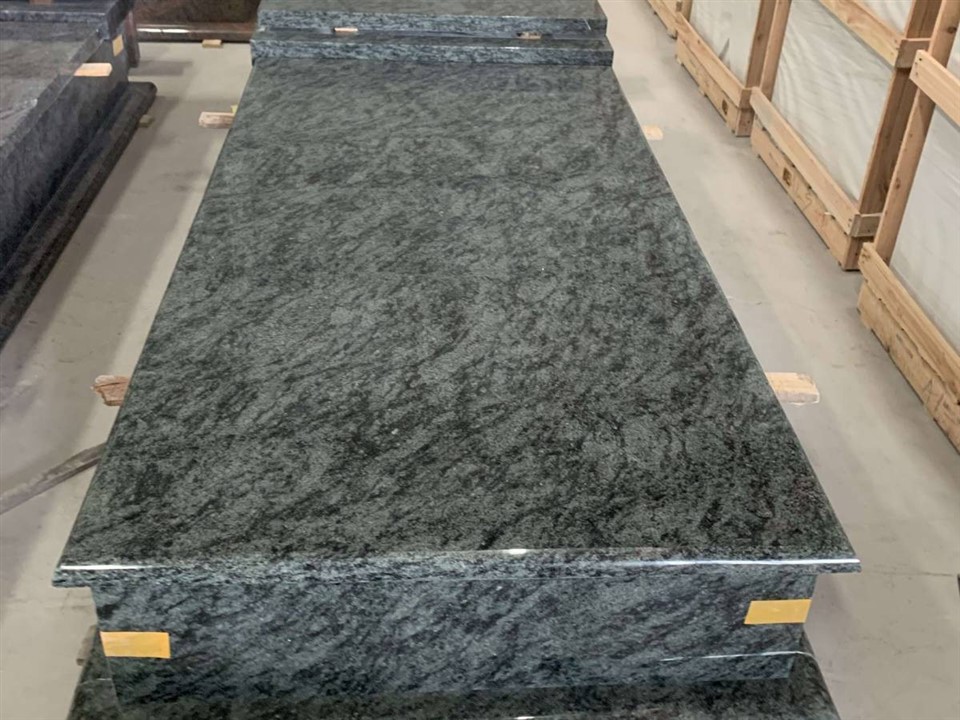
Process Extensibility of Two-Tone Designs on Heavy Ledger Slabs
Another major technical characteristic of traditional Slovakian monuments is their massive and heavy base structure. To break the monotony of a single dark stone, modern cemetery architectural designs increasingly require the introduction of geometric two-tone splicing between the central heavy Ledger Slabs and the perimeter granite kerb sets.
This design is not merely a visual modification; it is a test of material mechanics and surface treatment processes. Different granites have varying crystallographic structures, resulting in fundamental differences in Shore hardness and capillary water absorption rates. When processing surfaces via continuous linear polishing machines, the factory must adjust the grinding head pressure and RPM in real-time for different materials to ensure the physical high-gloss finishes of both the dark and light stones are completely equal (gloss meter readings must stabilize above 90). Simultaneously, the physical thermal expansion coefficients of the two stones must be strictly matched. Only by ensuring that the two stones will not extrude and crack due to uneven expansion forces under the extreme temperature differences of Eastern European winters and scorching summers, can the bulk-delivered granite kerb sets truly pass rigorous field climate testing.
Providing a One-Stop Two-Tone Granite Tombstone Kit to Maximize Installation Efficiency
In developed regions like Europe and the US, on-site construction labor costs at cemeteries are extremely high and often strictly regulated by unions and specific cemetery management ordinances. If the monument components procured by a distributor require workers to re-cut, slot, or recalibrate drill holes during on-site assembly, the exorbitant on-site labor fees will directly consume all profit margins of the entire trade order.
The optimal solution to this pain point is to require the source OEM factory to directly export a one-stop, integrated two-tone granite tombstone modular kit. This means that not only are the stela and base digitally aligned before leaving the factory, but all dowel holes for stainless steel pins used in monument erection are also pre-installed internally via CNC drilling centers. Before packing into heavy-duty wooden crates, the quality control team conducts a 100% factory-level Dry-Lay pre-assembly test and sends an imaging-grade QC report to the buyer. Upon receiving the goods, overseas buyers simply assemble and secure them with epoxy resin on-site, much like interlocking blocks. The on-site construction time for a single monument can be reduced by over 60%, helping wholesalers establish an absolute competitive barrier in their local markets.