

What is the electrical conductivity of Black Quartz Slabs?
Sep 19, 2025
Leave a message
What is the electrical conductivity of Black Quartz Slabs?
As a supplier of Black Quartz Slabs, I often encounter various inquiries from customers. One question that has piqued my interest recently is about the electrical conductivity of Black Quartz Slabs. In this blog, I'll delve into this topic, sharing scientific insights and highlighting the unique features of our products.
Understanding Quartz and Its General Properties
Quartz is a mineral composed of silicon and oxygen atoms in a continuous framework of SiO₄ silicon - oxygen tetrahedra, with each oxygen being shared between two tetrahedra, giving an overall chemical formula of SiO₂. It is one of the most abundant and widely distributed minerals on Earth.
Quartz is known for its hardness, ranking 7 on the Mohs scale of mineral hardness. This makes it highly resistant to scratching and wear, which is one of the reasons why quartz slabs, including Black Quartz Slabs, are popular for various applications such as countertops in kitchens and bathrooms, and Quartz Slabs Hotel Lobbies.
Electrical Conductivity Basics
Electrical conductivity is a measure of a material's ability to conduct an electric current. It is determined by the presence and mobility of charge carriers within the material. In metals, for example, there are free electrons that can move easily in response to an applied electric field, resulting in high electrical conductivity.
On the other hand, insulators have very few or no free charge carriers, so they do not conduct electricity well. Semiconductors have a conductivity that lies between that of conductors and insulators, and their conductivity can be controlled by factors such as temperature, doping, and the application of an electric or magnetic field.
Electrical Conductivity of Black Quartz Slabs
Black Quartz Slabs, like other quartz - based materials, are generally considered to be electrical insulators. The structure of quartz does not have a large number of free charge carriers. The silicon - oxygen bonds in quartz are covalent bonds, which means that the electrons are shared between the atoms and are not free to move throughout the material.
The black color in Black Quartz Slabs is often due to the presence of trace minerals or impurities. These impurities, however, do not typically introduce a significant number of free charge carriers that would increase the electrical conductivity of the slab. So, in normal conditions, Black Quartz Slabs have extremely low electrical conductivity.
This low electrical conductivity is an advantage in many applications. For instance, when used in buildings, it reduces the risk of electrical shock and interference. In kitchen countertops, it ensures that there is no electrical hazard when using electrical appliances on the surface.
Factors Affecting Electrical Conductivity
Although Black Quartz Slabs are insulators, there are some factors that could potentially affect their electrical conductivity to a small extent.
Moisture: If the Black Quartz Slab is exposed to a high - humidity environment or gets wet, the presence of water molecules on the surface can increase the conductivity slightly. Water can dissolve some ions from the surface of the slab or from the surrounding environment, and these ions can act as charge carriers. However, this effect is usually very small and temporary. Once the slab dries, the conductivity returns to its normal low level.
Temperature: In general, the electrical conductivity of insulators increases slightly with increasing temperature. As the temperature rises, the atoms in the quartz lattice vibrate more vigorously, which can free up a few more electrons or ions to act as charge carriers. But again, the change in conductivity is very minor compared to conductors or semiconductors.
Applications Leveraging Low Electrical Conductivity
The low electrical conductivity of Black Quartz Slabs makes them suitable for a wide range of applications.
Interior Design: As mentioned earlier, they are ideal for Quartz Slabs Hotel Lobbies. The non - conductive nature ensures the safety of guests and staff, especially in areas where there are electrical installations nearby. They can also be used in residential living rooms, bedrooms, and hallways, providing a stylish and safe surface.
Kitchen and Bathroom Countertops: In kitchens, where electrical appliances are commonly used, the low electrical conductivity of Black Quartz Slabs is a major advantage. It gives users peace of mind knowing that there is no risk of electrical problems. In bathrooms, where there is a lot of moisture, the non - conductive property also helps to prevent electrical hazards.
Our Black Quartz Slabs Offerings
As a supplier of Black Quartz Slabs, we take pride in the quality of our products. Our slabs are carefully crafted to ensure high purity and consistent properties. We source the best raw materials and use advanced manufacturing processes to produce Black Quartz Slabs that meet the highest standards.
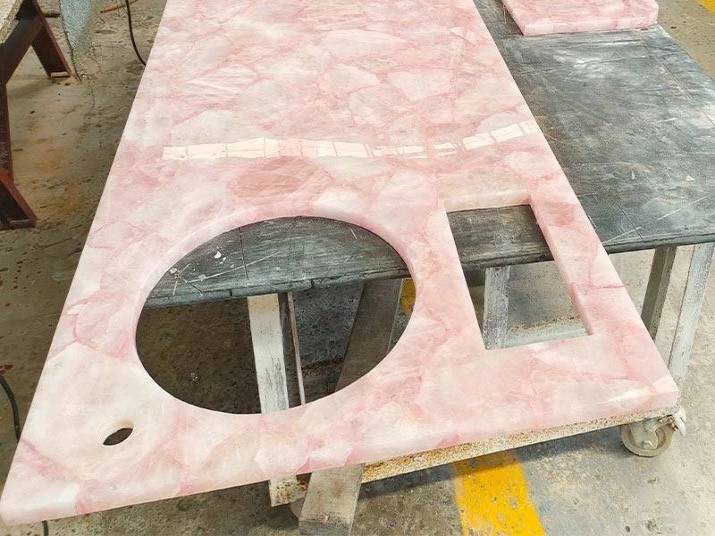
We offer a variety of sizes and finishes to meet the different needs of our customers. Whether you are looking for a large - scale installation for a commercial project or a small countertop for a home renovation, we have the right product for you. In addition to Black Quartz Slabs, we also have other options such as Pink Quartz Slab, which can add a touch of elegance to any space.

Contact Us for Procurement
If you are interested in our Black Quartz Slabs or have any questions about their properties, applications, or pricing, we encourage you to reach out to us. We have a team of experts who are ready to assist you with your procurement needs. Whether you are an architect, a contractor, or a homeowner, we can provide you with the best solutions. You can visit our website Black Quartz Slabs to learn more about our products and start the procurement process.
References
- Deer, W. A., Howie, R. A., & Zussman, J. (1992). Rock - forming Minerals: Volume 1 Silicates: Framework Silicates. Longman Scientific & Technical.
- Kittel, C. (2005). Introduction to Solid State Physics. John Wiley & Sons.