

Why UV-Stabilized Resin Matters in White Quartz Slabs
Apr 10, 2026
Leave a message
For importers and project contractors, supplying a multi-family housing development with bright, crisp white countertops is standard practice. However, the most expensive warranty claim you will face 12 months after installation is not structural failure-it is white quartz yellowing. When those pristine kitchen islands sit next to a sunlit window and slowly turn a murky, nicotine-stained yellow, the liability falls on the distributor.
The cause of this failure is rarely the stone itself; it is the chemistry of the binder. As an experienced OEM manufacturer, Stone Epic breaks down the exact chemical realities of resin formulations, helping you protect your supply chain from inferior manufacturing.
The Chemical Reality of White Quartz Yellowing
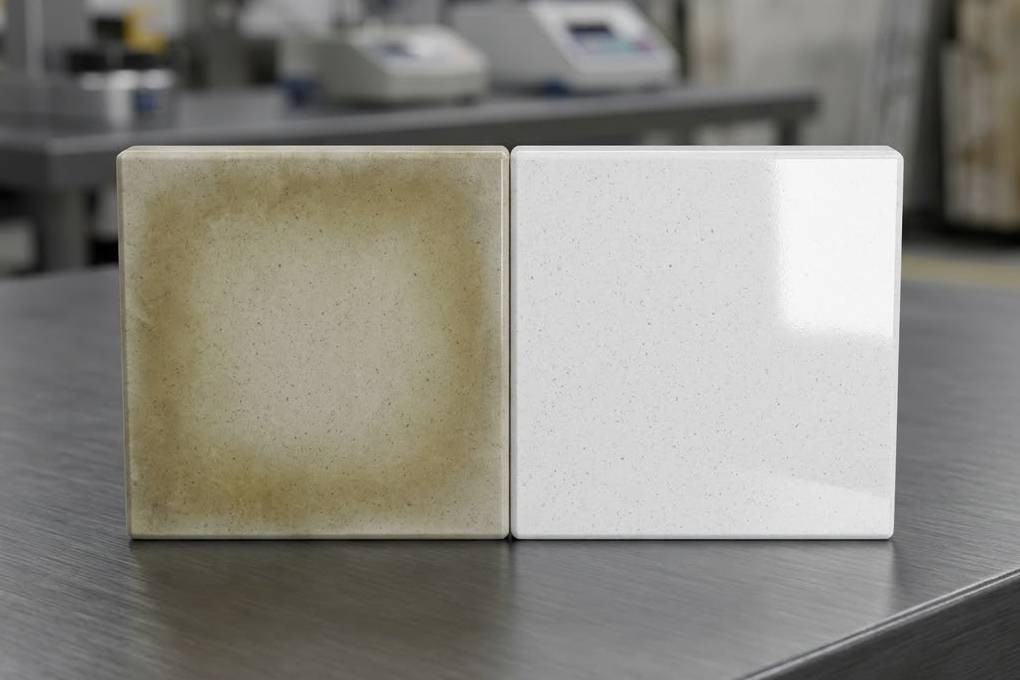
To understand the problem, you must look at the structural composition of the material. Pure white quartz slabs are typically composed of 93% natural quartz aggregates and 7% polymer resin. The natural quartz sand is inorganic and chemically inert; it will never change color under sunlight. The vulnerability lies entirely in the 7% resin matrix.
Standard manufacturing utilizes unsaturated polyester resins. When these standard polymers are exposed to prolonged Ultraviolet (UV) radiation from natural sunlight streaming through a kitchen window, the high-energy UV photons break the polymer chains. This chemical degradation process is known as photo-oxidation. Visually, this degradation manifests as a permanent, irreversible yellow or brownish tint on the surface of the countertop.
The Cost Discrepancy: Inferior vs. UV-Stabilized Resin
If the chemistry of yellowing is a known industry fact, why do so many factories still produce slabs that fail? The answer is strictly financial.
In the manufacturing of engineered stone, the resin is the most expensive raw material per kilogram. To win aggressive B2B bidding wars, low-tier factories utilize the cheapest available ortho-phthalic resins.
Producing true UV resistant quartz requires a significant increase in raw material costs. It demands the integration of premium, highly purified aliphatic resins mixed with advanced chemical additives, specifically Hindered Amine Light Stabilizers (HALS) and UV absorbers. These additives act as chemical shields, absorbing the UV radiation and dissipating it as low-level thermal energy before it can break the polymer bonds. Factories competing solely on the lowest price point physically cannot afford to include these critical stabilizers in their mixture.
Our products
Lorem ipsum dolor sit, amet consectetur adipisicing elit.

The Stone Epic Formulation Advantage in Malaysia
At Stone Epic, our manufacturing philosophy is engineered around long-term project stability. We do not compromise our chemical formulations to shave a few dollars off the production cost.
At our dedicated Malaysia processing facility, we have engineered a proprietary mixing protocol specifically for our white collections. We utilize ultra-clear, UV-stabilized polymer resins combined with iron-free, highly bleached quartz aggregates. Furthermore, our heavy-tonnage vacuum vibro-compaction presses eliminate microscopic air bubbles within the slab. Air pockets trap oxygen, which accelerates the photo-oxidation process. By creating a hyper-dense, oxygen-free resin matrix, we drastically extend the optical lifespan of the stone.
Additionally, by sourcing this highly stabilized material directly from our Malaysian hub, US-based importers secure a legally compliant, 100% AD/CVD tariff-free supply chain, bypassing the heavy anti-dumping duties levied against Chinese quartz imports.
How to Audit a Factory's Anti-Yellowing Protocols
If you are a purchasing director vetting a new quartz supplier, do not rely on visual inspections of a fresh sample in a dark showroom. Any newly polished slab looks perfectly white. To verify you are actually buying UV-stabilized material, you must ask targeted engineering questions during your factory audit:
- Request Weathering Data: Ask to see their accelerated weathering test reports (such as QUV weathering tester data or ISO 4892 compliance). A professional factory will have lab data proving how many hours their specific resin withstands intense UV exposure before color delta shifts occur.
- Inspect Resin Storage: Resin chemistry degrades if stored improperly. Check if the factory stores their raw polymer binding agents in strictly temperature-controlled environments.
- Identify the Aggregates: Ask about their sand purification process. Even with the best resin, if the white quartz sand contains trace amounts of iron oxide (rust), the slab will eventually discolor from within.
Securing a reliable source for commercial white quartz requires partnering with a manufacturer that understands advanced polymer chemistry. Contact the Stone Epic engineering team today to review our UV testing data and secure a consistent, high-yield supply for your next project.