

How to Choose Quartz Countertop Thickness for Commercial Projects
Aug 20, 2026
Leave a message

For many commercial quartz countertop projects, 20mm and 30mm are the two thicknesses buyers compare most often. Neither thickness is automatically the correct choice for every project. The decision should be made together with the countertop dimensions, cabinet or substrate design, visible edge profile, sink and appliance cutouts, island layout and the amount of fabrication to be completed before shipment.
StoneEpic's current engineered quartz range includes products offered in both 20mm and 30mm formats. Buyers should therefore treat thickness as one part of the complete fabrication specification rather than as a stand-alone product feature.
Start with the Finished Countertop, Not the Slab Thickness Alone
A project may use the same quartz design in different ways. A repeated apartment vanity, a long kitchen perimeter and a large feature island can all create different fabrication requirements even when the surface color is identical.
Thickness affects the visible edge, finished-piece weight, handling plan and the way edge build-ups or special profiles are detailed. It also needs to be coordinated with cabinet heights, appliance relationships, backsplash dimensions and the drawing used by the installer.
A Slimmer Countertop Specification
A 20mm quartz countertop is often considered when the project calls for a slimmer visual edge or when the approved design has already been developed around this finished thickness.
- Confirm the intended visible edge profile
- Check cabinet and finished-height coordination
- Mark sink and appliance openings clearly
- Review long or narrow components individually
A More Substantial Visible Edge
A 30mm quartz countertop creates a thicker exposed edge without relying on an additional laminated build-up. It should still be specified with the same drawing and fabrication details as the rest of the countertop set.
- Confirm the edge profile on every visible side
- Include finished-piece dimensions and quantities
- Coordinate sink, faucet and cooktop geometry
- Plan handling and packing for finished pieces
Thickness Changes How the Finished Edge Reads
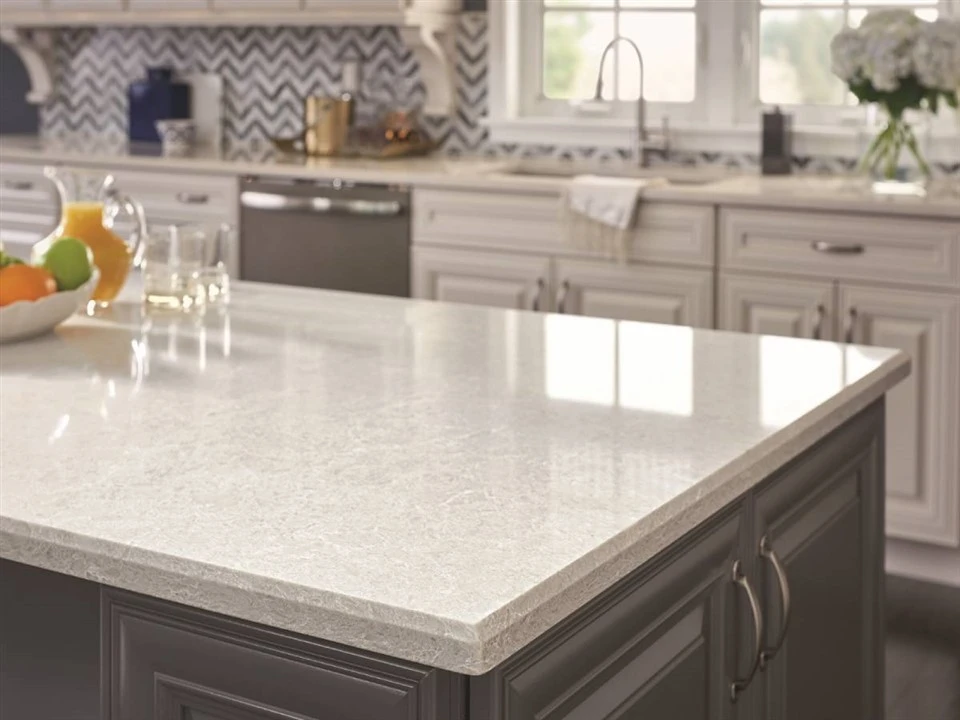
Countertop thickness is highly visible at exposed fronts, island ends and seating overhangs. The same quartz pattern can therefore produce a different finished appearance depending on whether the design uses a slimmer edge, a thicker solid edge or a fabricated edge treatment.
StoneEpic's Beveled Quartz Countertop illustrates why edge design and thickness should be discussed together. That product is currently offered in 20mm and 30mm formats, while the 45-degree bevel and visible bevel width are defined through the fabrication specification.
A buyer should not send only the words "20mm quartz" or "30mm quartz." Mark which edges remain visible, which sides meet walls or cabinets and whether returns, build-ups or special edge treatments are included.
20mm vs 30mm Quartz Countertop Procurement Matrix
| Procurement Factor | 20mm Quartz | 30mm Quartz | What the Buyer Should Confirm |
|---|---|---|---|
| Visible Edge | Slimmer finished appearance | More substantial solid edge | Edge profile and visible sides |
| Finished Height | Must match the approved cabinet and installation detail | Must match the approved cabinet and installation detail | Finished countertop elevation |
| Sink Cutout | Requires accurate opening geometry and piece review | Requires accurate opening geometry and piece review | Sink model, template and cutout position |
| Cooktop Opening | Coordinate the opening with the countertop drawing | Coordinate the opening with the countertop drawing | Appliance model and opening dimensions |
| Island Design | Useful where a slimmer visual line is specified | Useful where a thicker exposed edge is specified | Island size, overhangs and visible sides |
| Fabrication | Can include custom edges, openings and cut-to-size work | Can include custom edges, openings and cut-to-size work | Complete drawing and piece schedule |
| Quotation | Quote as a complete finished scope | Quote as a complete finished scope | Thickness alone is not enough for pricing |
Thickness Does Not Replace Accurate Sink and Appliance Information

Selecting 20mm or 30mm is only one decision in a finished countertop order. Sink cutouts, faucet holes, cooktop openings and inside corners can remove material from the slab and create narrow sections that require careful drawing review and handling.
For factory-fabricated pieces, send enough information to identify the opening precisely:
- Sink or appliance manufacturer and model
- Dimensioned opening or approved template
- Opening position from finished edges
- Faucet and accessory hole positions
- Required edge treatment around the opening
- Countertop piece code and drawing revision
Buyers planning finished kitchens can also use StoneEpic's Countertop & Vanity supply route to organize countertop dimensions, openings, edges and related pieces.
Choose the Thickness and Edge Profile as One Detail
An edge profile changes how the selected thickness is perceived. A straight or eased profile generally keeps the actual slab thickness visually clear, while beveled or customized edge work changes the front geometry.
Show the Material Thickness Clearly
Specify the exposed edges and required finishing so the countertop drawing identifies where the profile continues or stops.
Define More Than the Angle
A bevel should include the intended edge location and visible width rather than relying on the edge name alone.
Use a Drawing or Profile Detail
Customized edges should be released with the fabrication drawing so quotation and production use the same geometry.
Check Slab Format Before Finalizing the Island Layout
Countertop thickness and slab dimensions should be reviewed together for large islands. StoneEpic's current quartz catalog includes several engineered quartz products in a 3200 × 1600mm slab format, including the Calacatta Gold Quartz Countertops product.
A nominal slab size is not the same as an automatically usable finished island size. The cutting plan also has to account for finished dimensions, openings, required edges, pattern direction and the actual slab or product reference used for the order.
For Calacatta-style designs, the full-pattern orientation can matter as much as thickness. The approved quartz reference and fabrication drawing should therefore remain connected before the order is released.

Use the Installation and Procurement Model to Narrow the Choice
Start with the approved unit types and countertop schedule. Standardizing thickness, edges, cutouts and backsplash details can make repeated fabrication easier to control.
Coordinate finished height, basin openings, faucet holes, front edges and side conditions across the room schedule rather than choosing thickness separately.
Review visual edge thickness together with island dimensions, overhangs, vein direction and any waterfall or exposed end conditions.
If slabs will be fabricated after import, confirm the thickness and slab format required by the local fabrication and installation plan.
Submit finished drawings because thickness becomes one part of a larger scope covering cutting, openings, edge processing, piece codes and packing.
Specify More Than "20mm" or "30mm"
- Quartz product name or current code
- 20mm or 30mm required thickness
- Surface finish
- Finished dimensions for every piece
- Quantity by unit or piece type
- Sink and appliance openings
- Faucet and accessory holes
- Edge profiles and exposed sides
- Backsplash or return pieces
- Pattern direction where relevant
- Approved drawing revision
- Destination country or port
Why Thickness Alone Cannot Produce a Comparable Countertop Quote
A quotation based only on square meters and thickness leaves too much of the fabrication scope undefined. One project may require simple rectangular pieces, while another using the same quartz thickness may include multiple sink cutouts, appliance openings, finished returns and detailed edge processing.
The most useful RFQ therefore combines material selection with a piece schedule or drawing. StoneEpic's Quartz Selection process already separates product reference, finished form, pattern approval and drawing information so the visual specification and fabrication specification remain connected.
For drawing review and project coordination, buyers can also continue to StoneEpic Project Support.
A Practical Five-Step Thickness Approval Process
Choose the Quartz Reference
Approve the product code, visual direction and required surface finish before assigning finished pieces.
Choose 20mm or 30mm
Match the thickness to the approved design, cabinet or substrate condition and finished countertop detail.
Define the Fabrication Scope
Add openings, finished edges, backsplashes, returns and piece codes to the same drawing package.
Review the Layout
Check slab format, joint positions and pattern direction for islands or design-led quartz products.
Release One Approved Revision
Use the same product reference and drawing revision for quotation, fabrication checks and final piece identification.
Quartz Countertop Thickness FAQ
Is 20mm or 30mm quartz better for countertops?
Neither thickness is automatically better for every project. Select the thickness together with the finished design, cabinet or substrate condition, edge profile, openings, island layout and fabrication scope.
Does StoneEpic supply both 20mm and 30mm quartz countertops?
Several current StoneEpic engineered quartz products list both 20mm and 30mm options. Confirm the available thickness for the exact quartz reference included in your project quotation.
Does countertop thickness affect the edge profile?
Yes. The selected slab thickness contributes to the visible edge geometry. Straight, eased, beveled and customized profiles should therefore be specified together with the thickness and exposed-edge locations.
Is thickness enough information for a quartz countertop quote?
No. A useful quote should also include the quartz reference, finished dimensions, quantities, surface finish, openings, edge profiles, backsplashes, destination and drawings when factory fabrication is required.
Should thickness be selected before the sink cutout is planned?
Thickness can be selected early in the design, but the final fabrication release should include both the thickness and accurate sink or appliance geometry on the approved drawing.
What should I send StoneEpic to review a commercial quartz countertop project?
Send the quartz product reference, required thickness, finish, countertop dimensions, quantities, sink or appliance openings, visible-edge requirements, backsplashes, destination and the latest fabrication drawings.
Choose the Quartz Thickness with the Complete Countertop Specification
If your project is comparing 20mm and 30mm quartz countertops, send the countertop or vanity dimensions together with the selected quartz reference, quantity, edge requirements and sink or appliance openings. Drawings make it easier to review thickness as part of the complete finished-product scope.