

Calibrating Thickness Tolerances for Commercial Hospitality Vanity Tops
May 21, 2026
Leave a message
The Need for Absolute Thickness Consistency
When managing a 300-room or 500-room hotel project, construction speed and labor efficiency dictate your final profit margins. If a batch of commercial hospitality vanity tops arrives at the job site with varying thicknesses-say, 18mm on one end and 22mm on the other-your installation team will hit an immediate bottleneck.
Carpenters and installers will be forced to manually shave down wooden cabinet bases or use dozens of custom shims to level the stone. Over hundreds of bathrooms, these "minor adjustments" destroy your labor budget and lead to uneven silicone joints against the drywall. In high-volume commercial projects, dimensional predictability is not a luxury; it is a strict requirement. This is exactly where advanced stone manufacturing processes separate professional factory floors from amateur cutting workshops.
Block Cutting vs. Factory Calibration
To understand why thickness variations happen, you have to look at the raw extraction and slicing process. When massive stone blocks are sliced into slabs, factories use multi-blade gang saws. As these massive steel blades cut through dense igneous rock, the blades naturally vibrate and deflect slightly. This unavoidable mechanical deflection results in a raw slab that is inherently uneven, often varying by 2mm to 4mm across its surface. While a small local fabricator might ignore this for a single residential kitchen, it is a disaster for bulk commercial orders.
To solve this inherent flaw, our facility runs the raw slabs through multi-head calibration machines before any cutting or polishing takes place. These heavy-duty machines use a series of spinning diamond rollers to physically mill the back of the stone completely flat. Whether you are specifying premium quartz or cost-effective Level 1 granite countertops, this secondary calibration process guarantees a strict +/- 1mm tolerance. Every single piece in your shipping container will sit perfectly flush on the vanity cabinet the second it is unboxed.
Our products


The Advantage of CNC Faucet Drilling
Thickness calibration doesn't just help the carpenters; it is absolutely critical for the plumbing contractors. Commercial plumbing fixtures, such as high-traffic Moen or Kohler faucets, come with threaded mounting shanks designed for a specific stone thickness.
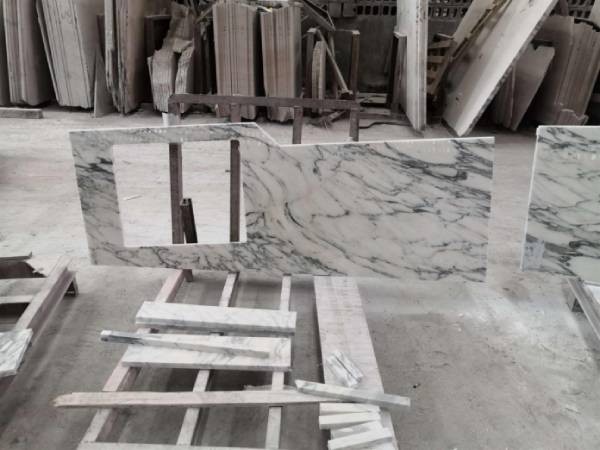
If a vanity top is too thick near the back edge, the plumber will not be able to thread the securing nut onto the faucet shank, forcing them to grind the stone on-site-creating dust, risking fractures, and wasting time. By combining a perfectly flat, calibrated underside with standardized CNC faucet drilling, we eliminate this on-site guesswork entirely. Our digital routers bore every sink cutout and faucet hole to exact millimeter specifications. This ensures that the hardware drops effortlessly into the commercial hospitality vanity tops, allowing plumbing crews to move rapidly from room to room.
Turnkey Delivery for Hotel Contractors
Large-scale hotel builds require a supply chain that offers both heavy industrial capacity and customized precision. Massive, rigid slab factories often reject the intricate specifications required for custom hotel vanities, while small fabrication shops simply cannot handle the required volume or tight delivery schedules. Our mid-sized, highly flexible production line is engineered specifically to bridge this gap in the market.
We focus purely on delivering a "plug-and-play" product. From the exact moment your installation crew uncrates your pallet of Level 1 granite countertops, the stones are pre-sealed, precisely calibrated, perfectly drilled, and ready for immediate installation. Delivering this level of engineered reliability and eliminating hidden on-site labor costs is the true value of partnering with a dedicated stone manufacturing facility.