

Translating CAD Drawings into Custom Granite Monuments: A Guide
May 28, 2026
Leave a message
From Hand Sketches to CNC Production
When grieving families commission a memorial, they typically provide retail distributors with emotional, hand-drawn sketches or rough physical mock-ups. While these concepts hold profound sentimental value, they are structurally useless on an industrial factory floor. Multi-axis CNC bridge saws and routers do not interpret artistic intent; they only execute absolute Cartesian coordinates via G-code. Transforming a paper sketch into a precise, machinable DXF file requires specialized granite monument CAD design. This digitization process is the critical engineering bridge between a loose visual concept and mass production. It forces our drafting engineers to define exact material thicknesses, draft angles for rainwater runoff, and specific center-of-gravity (CG) load calculations. Without this rigid digital framework, it is impossible to guarantee that a top-heavy memorial structure will not tip over and fracture after installation.
Tool Radius Compensation Realities
The most frequent engineering conflict we encounter between a client's paper sketch and physical stone involves internal corners. A pencil can easily draw a mathematically perfect, sharp 90-degree internal right angle. However, manufacturing physics dictate that a CNC machine utilizes spinning cylindrical diamond finger bits. Because the bit is a cylinder, it simply cannot mill an absolute sharp internal corner; it will always leave a residual curve equal to the exact radius of the cutting tool (e.g., a 20mm diameter tool inevitably leaves a 10mm corner radius). This is a fundamental machining law known as tool radius compensation.
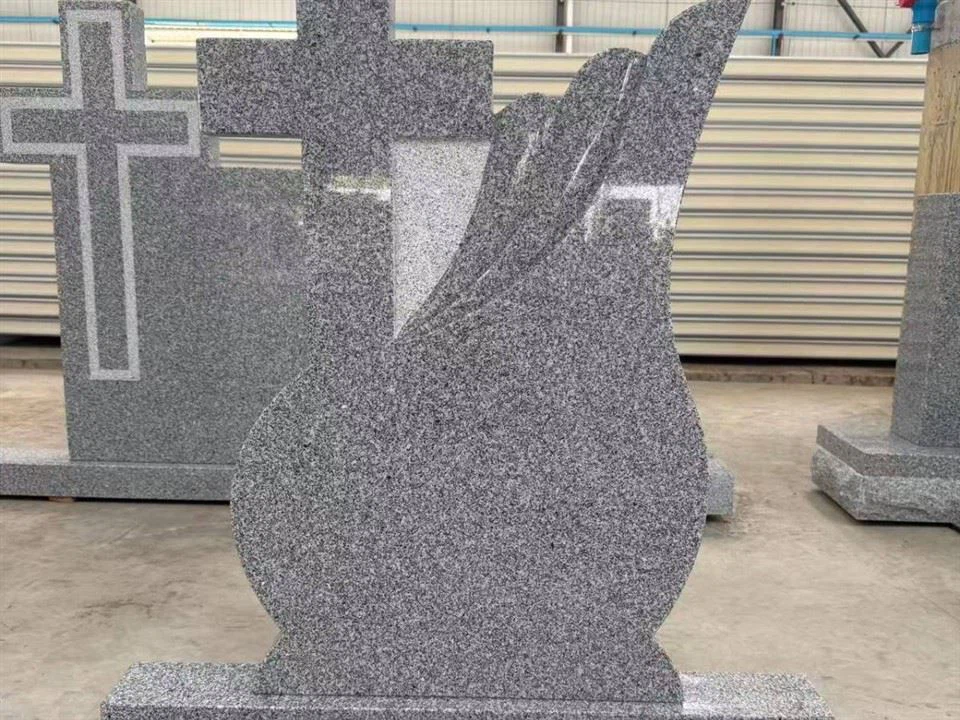
If a distributor orders highly complex custom granite monuments featuring intricate interlocking crosses or deeply stepped bases, our factory engineers must modify the original drawing to reflect physical reality. We either introduce a deliberate internal fillet (a slight visible curve) or program a "dog-bone" overcut hidden beneath the joint line to ensure the mating parts fit correctly. Failing to execute this digital compensation means the physical stone pieces will violently collide during cemetery assembly.
Our products


Predicting and Avoiding Joint Tolerances
Stone is a rigid, unforgiving material with zero elasticity. When manufacturing multi-piece memorial assemblies-such as a plinth, a sub-base, and a vertical stela-the mathematical fit must be flawless. Utilizing advanced granite monument CAD design software allows our technical department to run digital interference checks long before a single block of raw granite is loaded onto the cutting table.
We actively predict and manage joint tolerances by digitally assembling the 3D models. In the software, we intentionally design a 1.5mm to 2.0mm micro-gap at all structural vertical intersections. This specific tolerance accommodates the volume of marine-grade epoxy during curing and allows for the natural thermal expansion of heavy custom granite monuments during seasonal temperature swings. If a factory attempts to machine stone with a zero-tolerance flush fit, the friction during on-site positioning will inevitably chip the polished edges.
1:1 Digital Templates for Wholesalers
The final, non-negotiable step before triggering mass production is establishing an airtight approval protocol. A professional wholesale headstone supplier does not just send an invoice and start cutting; they provide verifiable engineering data to the buyer.
We generate and export a 1:1 scale electronic template (in DXF or high-resolution PDF format) containing precise millimeter dimensions, radial curves, and exact stainless-steel dowel pin hole coordinates. Your regional sales team can print this template at full scale to physically verify the lettering layout and overall proportions with the end consumer. Furthermore, your local fabrication shop can feed this exact vector file directly into their automated sandblasting or laser etching plotters. This rigorous digital handshake protects the wholesale headstone supplier from expensive post-delivery dimension disputes, guaranteeing that what you approved on the monitor is exactly what arrives in your shipping container.