

What is the chemical composition of grey quartz countertops?
Aug 25, 2025
Leave a message
Hey there! As a supplier of Grey Quartz Countertops, I often get asked about what exactly goes into making these stylish and durable surfaces. So, I thought I'd take a deep dive into the chemical composition of grey quartz countertops and share all the cool stuff I've learned.
First off, let's talk about the star of the show: quartz. Quartz is one of the most abundant minerals on Earth, and it's a key ingredient in grey quartz countertops. Chemically, quartz is made up of silicon and oxygen atoms, with the chemical formula SiO₂. That's right, it's a simple combination of silicon and oxygen, but it forms a super strong and stable structure.
In grey quartz countertops, the quartz crystals are usually sourced from natural deposits. These crystals are then crushed and ground into a fine powder. The purity of the quartz used can vary, but high - quality grey quartz countertops typically use quartz that's at least 90% pure. This high purity ensures that the countertops are strong, resistant to scratches, and have a long lifespan.
But quartz alone isn't enough to make a countertop. That's where the resin comes in. Resins are polymers that act as a binder, holding the quartz particles together. There are different types of resins used in the manufacturing of grey quartz countertops, but the most common ones are polyester and epoxy resins.
Polyester resins are cost - effective and widely used. They are relatively easy to work with and can be formulated to have different properties. Epoxy resins, on the other hand, are more expensive but offer better chemical resistance and a higher level of durability. In many grey quartz countertops, a combination of these resins is used to get the best of both worlds.
The resin makes up about 7 - 10% of the total composition of the countertop. It not only binds the quartz particles but also fills in the gaps between them, creating a smooth and solid surface. The resin also gives the countertop its ability to be molded into different shapes and sizes, which is great for custom installations.
Now, let's talk about the color. Grey quartz countertops get their color from a combination of pigments and the natural color of the quartz itself. Pigments are finely ground powders that are added to the resin - quartz mixture during the manufacturing process. These pigments can be inorganic or organic.
Inorganic pigments are often used because they are more stable and fade - resistant. They can be made from various metals and metal oxides. For example, iron oxides are commonly used to create different shades of grey. By adjusting the amount and type of pigment, manufacturers can achieve a wide range of grey tones, from light silver - grey to deep charcoal.
Some grey quartz countertops also have a bit of sparkle or veining. This can be achieved by adding small amounts of other minerals or materials. For instance, mica flakes can be added to give the countertop a sparkly effect. Mica is a mineral that has a natural shimmer, and when it's embedded in the countertop, it catches the light and adds a touch of elegance.
Veining can be created by using different techniques. Sometimes, it's simply a matter of how the resin and quartz are mixed and poured during the manufacturing process. Other times, additional pigments or materials are used to create the veining effect, mimicking the look of natural stone.
One of the great things about grey quartz countertops is their consistency. Unlike natural stone, which can have variations in color and pattern from slab to slab, grey quartz countertops are manufactured to have a more uniform appearance. This makes it easier to match countertops in different parts of a kitchen or bathroom.
When it comes to the benefits of grey quartz countertops, their chemical composition plays a big role. Thanks to the high percentage of quartz, they are extremely hard and scratch - resistant. You can cut and chop on them without worrying about leaving permanent marks. The resin binder also makes them resistant to stains. Most common household spills, like coffee, wine, and oil, won't penetrate the surface if they are cleaned up promptly.
Another advantage is their resistance to heat. While you shouldn't place hot pots and pans directly on any countertop, grey quartz countertops can withstand a fair amount of heat without getting damaged. This is because the quartz and resin combination has good thermal stability.

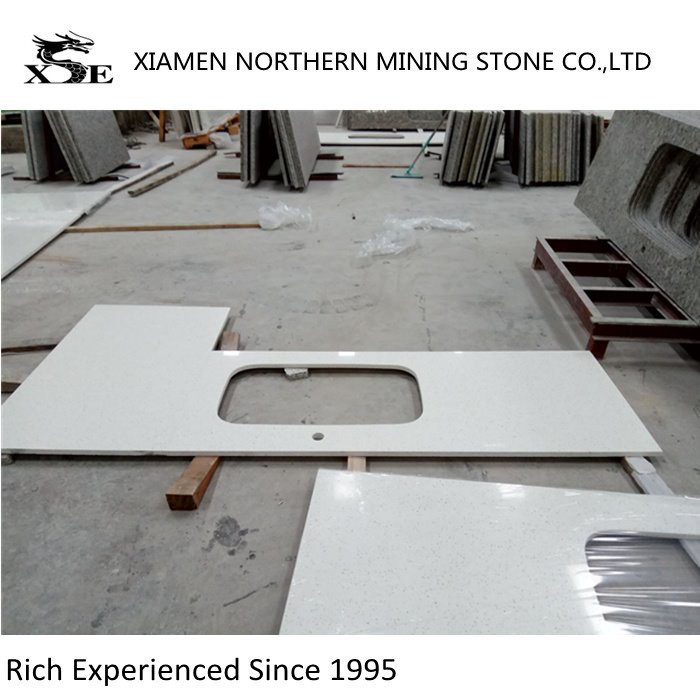
If you're in the market for grey quartz countertops, you might be interested in checking out our Quartz Slabs Library Countertops. It's a great resource to see the different options available. We also have some beautiful Solid White Quartz Vanity Top and White Sparkle Quartz Countertop if you're looking for something other than grey.
In conclusion, the chemical composition of grey quartz countertops is a carefully balanced mix of quartz, resin, pigments, and sometimes other additives. This combination results in a countertop that is not only beautiful but also highly functional. Whether you're renovating your kitchen or building a new home, grey quartz countertops are a great choice.
If you're interested in purchasing grey quartz countertops or have any questions about our products, feel free to reach out. We're here to help you find the perfect countertop for your space.
References
- "Quartz Countertops: A Comprehensive Guide" by Countertop World Magazine
- "The Science of Stone Surfaces" by The Stone Institute