

Preventing Resin Pooling in Engineered Stone Quality Control
Jul 10, 2026
Leave a message
Quartz resin poolingis a chemical distribution failure where excess liquid polymer binder aggregates on the slab surface, creating visually inconsistent, low-hardness blotches. Eliminating this defect requires maintaining a strict 93:7 quartz-to-resin ratio under high-tonnage Vacuum Vibro-Compaction, ensuring uniform physical density for large-scale commercial paving.
The Economics of Defect: High Resin Ratios in Inferior Fabrication
In the manufacturing of engineered stone, high-purity silica sand is significantly more expensive than liquid epoxy resin. Furthermore, pressing a mixture with a high ratio of natural quartz requires immense hydraulic force and electrical consumption. To reduce FOB costs, inferior OEM facilities manipulate the formula, increasing the resin ratio from the standard 7% up to 10% or even 12%.
This cost-cutting measure directly causes resin pooling. When a slab contains excess epoxy resin, the binder cannot fully coat the aggregate; instead, it pools together during the vibration phase. Once cured, these resin pools manifest as cloudy, discolored patches. Because resin has a Mohs hardness of only 3.0 (compared to quartz at 7.0), these aggregated spots are highly susceptible to scratching, chemical etching, and UV degradation. In a commercial setting with thousands of square feet of continuous flooring, a single slab with resin pooling destroys the architectural visual consistency and triggers immediate contractor rejections.
Vacuum Vibro-Compaction at Malaysia In Quartz Stone SDN.BHD.
Operating as a highly focused, mid-sized OEM facility, our Malaysia In Quartz Stone SDN.BHD. Factory relies on strict mechanical engineering rather than chemical shortcuts to bind our slabs.
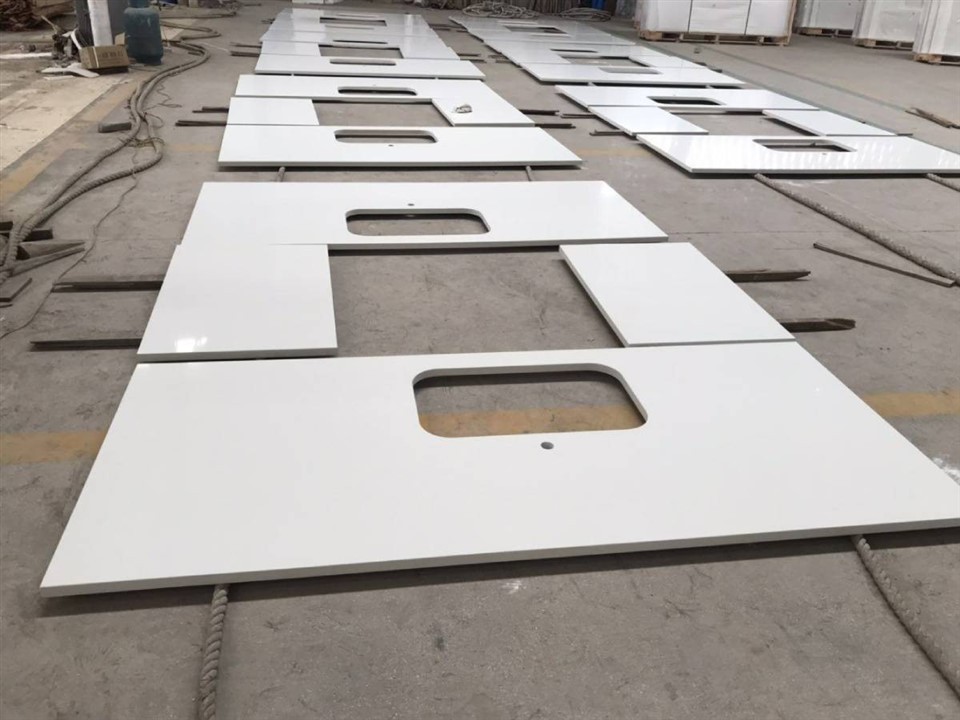
To manufacture flawless pure white quartz slabs-where any discoloration is instantly visible-we enforce a rigid maximum resin threshold of 7%. Because this low-resin mixture is extremely dense and difficult to mold, we deploy industrial Vacuum Vibro-Compaction presses. The raw mixture enters a vacuum chamber that removes 100% of atmospheric air, preventing internal micro-voids. Simultaneously, heavy-tonnage hydraulic plates apply extreme downward force while vibrating at high frequencies. This mechanical action forces the minimal epoxy resin into a microscopic, ultra-thin binding network around every individual quartz crystal, making resin pooling physically impossible.
| Manufacturing Metric | Inferior OEM Facility | Malaysia In Quartz Stone SDN.BHD. | Physical Impact on Finished Slab |
|---|---|---|---|
| Quartz-to-Resin Ratio | 88% Quartz / 12% Resin | 93% Quartz / 7% Resin | Eliminates surface resin pooling |
| Compaction Technology | Low-pressure static press | High-tonnage Vacuum Vibro-Compaction | Secures uniform specific gravity >2.35 g/cm³ |
| Curing Protocol | Rapid heat (induces warp) | Controlled exothermic calibration | Prevents internal stress fracturing |
| Surface Hardness | Variable (Mohs 4.0 in pools) | Uniform Mohs 7.0 across entire slab | Resists commercial abrasive wear |
Our product

High-Intensity Light QA/QC Protocols for Defect Identification
Visual inspection under standard factory overhead lighting often fails to detect minor resin pools, allowing defective material to be loaded into the 20ft FCL. Effective engineered stone quality control requires aggressive, targeted lighting protocols before the ISPM-15 crates are sealed.
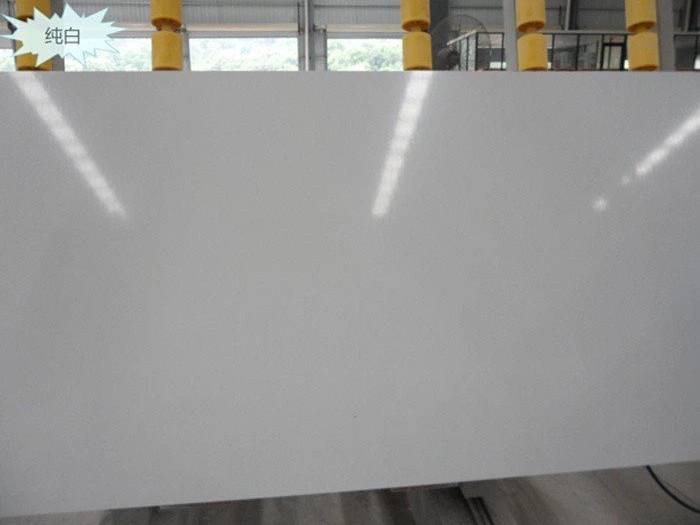
Our QA/QC managers utilize high-intensity LED inspection lamps positioned at a low 15-degree angle across the polished surface of the slab. While the quartz aggregates reflect light sharply, resin pools absorb the light, revealing themselves as dull, hazy depressions. Every slab must pass this glancing-light test to verify absolute surface uniformity. We document this process using timestamped 4K photography, providing B2B buyers with empirical proof of quality before the vessel leaves the port. For further protocols on defect elimination, review our guide on Controlling Black Dots in Pure White Quartz Countertops.
Procurement FAQs
Q: What causes quartz resin pooling in commercial slabs?
A: Resin pooling occurs when a factory exceeds the 7% epoxy resin threshold to lower production costs and reduce the mechanical pressing force required. The excess liquid binder separates from the quartz aggregates and pools on the surface during the vibration stage.
Q: How do you identify resin pools during engineered stone quality control?
A: Standard overhead lighting masks the defect. QA/QC inspectors must shine a high-intensity LED light at a 15-to-20-degree angle across the polished slab. Resin pools will appear as dull, cloudy patches that disrupt the uniform gloss reflection of the quartz.
Q: Why specify pure white quartz slabs from your Malaysia facility?
A: Our Malaysia In Quartz Stone SDN.BHD. facility utilizes advanced Vacuum Vibro-Compaction to press slabs with a strict 93:7 quartz-to-resin ratio, guaranteeing zero resin pooling. Furthermore, direct manufacturing in Malaysia provides US importers with a 100% AD/CVD-Free and Tariff-Free supply chain.
Call to Action: Do not let inferior material blends compromise your commercial installations. Contact our QA/QC Engineering Team today to request our high-intensity light inspection reports, review our AD/CVD-Free compliance documentation, or initiate a direct FOB quotation from our Malaysia factory.